Works · Rights · About · Texts · Contact · ES →
The number arrived on its own, ahead of the data.
A single digit on his phone screen. No explanation. No context. Just the number, black on white, posted by the prime minister on his social media at ten in the morning on a Monday in April.
Marcos saw it from the waiting room of a logistics company in the north industrial park.
He’d been sitting forty minutes in a blue plastic chair in front of a frosted glass window. Ten other people were there. None of them looked at each other. All of them looked at their phones.
He’d taken a number from the dispenser when he came in: twenty-one.
He still had it in his hand.
At ten-fifteen they called number nineteen.
Marcos was thirty-four years old, had an MBA he’d paid for in installments, and had sent out a hundred and seventeen job applications since October. Of those, sixteen had made it to a first interview. Four to a second. None to a third.
He opened the jobs app. At the top, a blue banner:
Spain reaches 22 million registered workers. The best March on record.
He closed it.
In the chair next to him, a woman in her early fifties was rereading a sheet of paper folded into quarters. She’d folded and unfolded it three times since Marcos got there. The paper had something written on it by hand that he couldn’t read.
Number twenty took twelve minutes.
Marcos thought about his father.
Plumber. Self-employed since he was twenty-two. Forty-one years of contributions and not a single résumé sent in his entire life. His clients called him. When he retired in January, he gave them Marcos’s number. Without asking him first.
He told him afterward, one night, almost in passing:
—In case you’re ever interested.
Marcos didn’t answer.
Since then, his phone had rung four times. Two broken heaters, a cracked drain, a leak on the fifth floor of a walk-up. He’d picked up each time, said he wasn’t a plumber, he was sorry, then looked up someone else online and passed along the number.
The last time, the person on the other end took a moment before responding.
—It’s just, your father took care of us for twelve years. There’s no one to find anymore.
Marcos put the phone away without answering.
He looked at his hands.
He didn’t own a single tool. He never had.
They called number twenty-one.
He stood up. Grabbed the folder with his résumé copies, his MBA diploma, and the two letters of recommendation that had taken him three weeks to get. He went through the door to the window. Inside was a young man with headphones, a screen turned away from him, and a paper form.
—Name and ID.
He gave them.
The man typed something. Waited. Typed something else.
—The position’s already been filled. We got a candidate yesterday afternoon.
Marcos looked at the folder in his hand.
—Are there any other openings?
—Not right now. You can leave your résumé if you’d like.
He left it.
The man put it on a tray that already had six others on top of it.
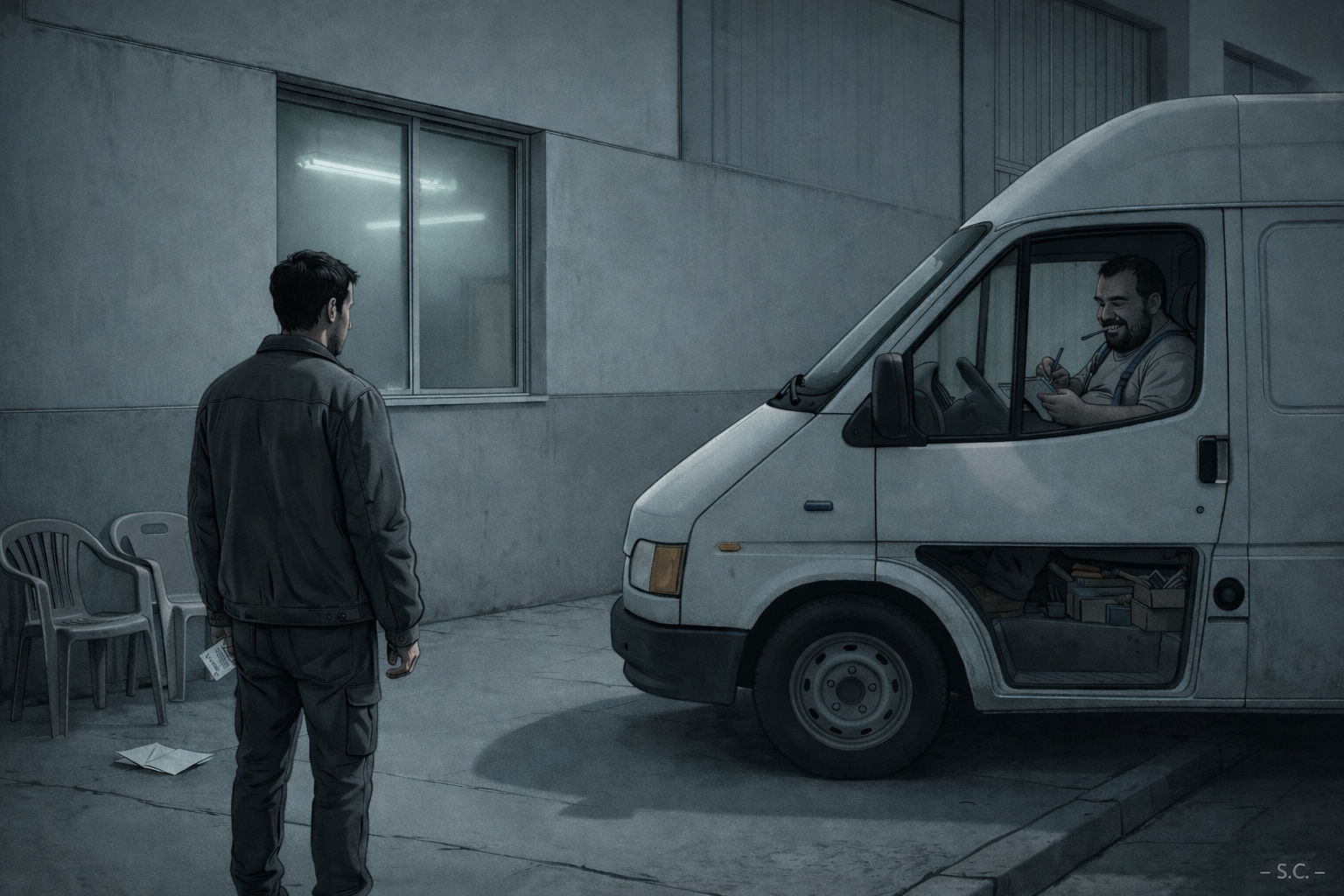
Outside, the sun cut in from the side. A white work van was parked badly on the sidewalk. On the side panel, in blue letters: Aguado Brothers Plumbing. Emergency Service 24/7.
The driver was inside, on the phone. Laughing. Writing something in a notepad with a pen he kept between his teeth whenever he needed both hands.
Marcos stood there watching.
The prime minister had posted a second message. A video. National team jersey. The number 22 on the back.
You’re the ones who open the gates, who care, who teach, who build this country.
The driver hung up.
Dialed another number.
Kept writing.
As Marcos passed the empty chair, the sheet of paper was still on the floor.
Folded into quarters.
He looked at the slip of paper still in his left hand.
Twenty-one.
He folded it.
Put it in his pocket.
Santiago Copí
More texts and full catalog at Works. For literary representation or editorial inquiries: Contact.
 Santiago Copí