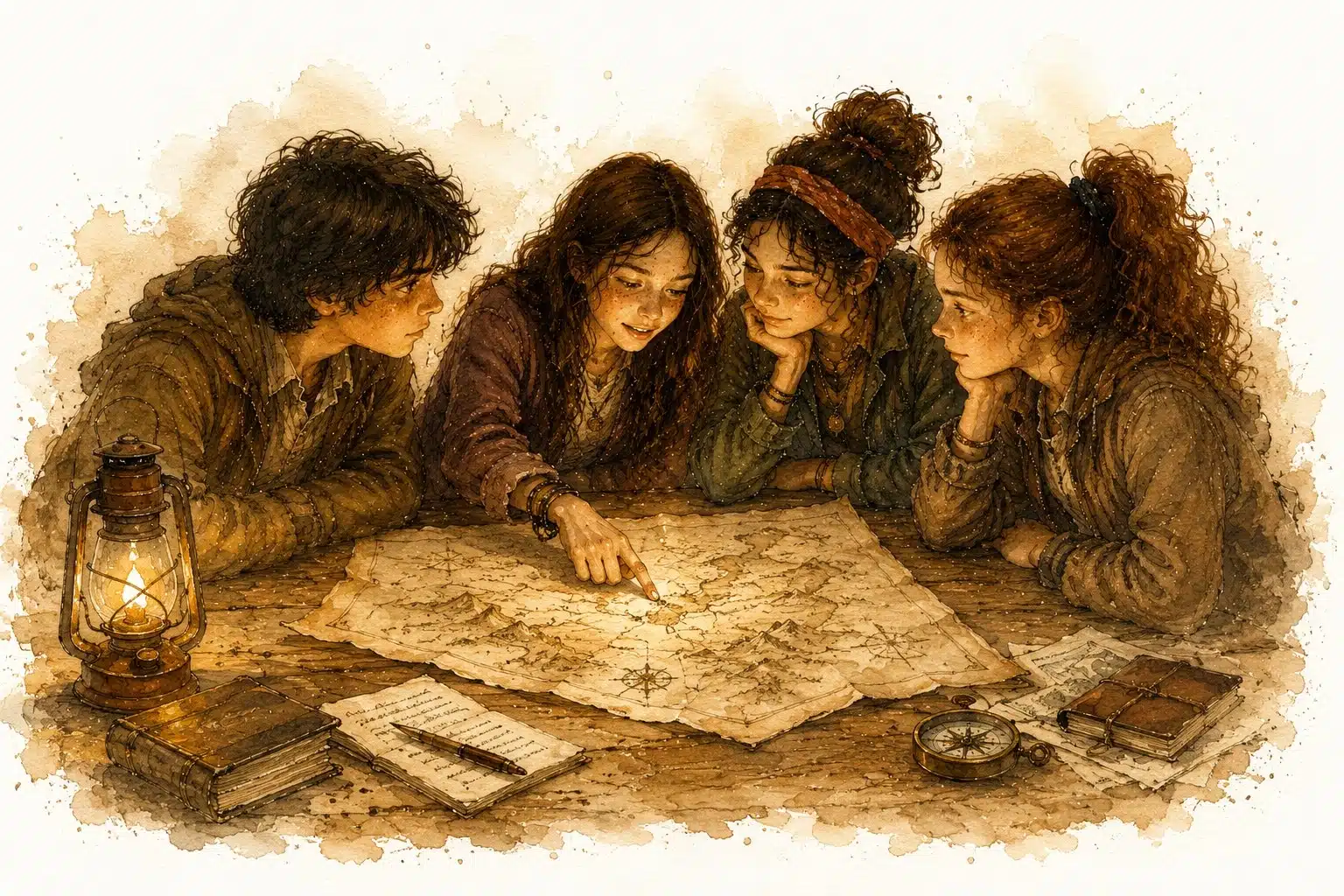

Every Child Inherits a Map.
Long before children understand the world…
they begin drawing a map of it.
Not with pencil.
Not with ink.
With experience.
•
A parent’s voice becomes a road.
A teacher’s encouragement becomes a bridge.
A disappointment becomes a mountain.
A friendship becomes a place worth returning to.
A fear becomes a territory they avoid for years.
Little by little, every child creates an invisible map that will guide countless choices long before they are old enough to explain why.
•
The question is not whether children will inherit a map.
They all do.
The real question is this:
Who will help draw it?
•
We live in an age that has become astonishingly good at capturing children’s attention.
But attention is not the same as direction.
A screen can tell a child where to look.
Only a story can change what they learn to see.
•
That is why books still matter.
Not because they compete with technology.
Because they shape imagination.
And imagination is where character quietly begins.
•
The greatest children’s stories have never been instruction manuals disguised as adventures.
They have never succeeded because they explained kindness.
Or courage.
Or friendship.
They succeeded because they allowed young readers to live those things before life demanded them.
•
Children rarely remember what adults try to teach them.
They remember how a story made them feel.
The friend who refused to walk away.
The mistake that became the beginning instead of the end.
The moment someone chose compassion over certainty.
Those moments become landmarks.
Years later, children may forget the plot.
They almost never forget the person they became while reading it.
•
That is why choosing a children’s book is never simply choosing entertainment.
It is deciding who gets permission to draw another line on a child’s map.
•
That belief became the foundation of The First Heartbeat of the Map.
Not the idea that stories should teach.
Stories are at their weakest when they teach.
Stories are at their strongest when they awaken.
•
This novel was written around a simple conviction:
Children do not need perfect heroes.
They need truthful ones.
They need characters who hesitate.
Who fail.
Who misunderstand each other.
Who discover that asking for help is not weakness.
That courage often looks quieter than victory.
That every meaningful journey eventually reaches a point where no one can continue alone.
•
At the heart of the story lies a map.
Not simply as an object to be found.
But as a reminder that no single person ever carries the whole picture.
Each child sees something another cannot.
Each mistake reveals something success never could.
Each act of trust redraws the path forward.
•
Perhaps that is why stories remain one of education’s most remarkable tools.
They allow children to practise empathy before life requires it.
They allow them to experience failure without being defeated by it.
They allow them to recognise loneliness before someone they love feels it.
They allow them to discover that differences are not obstacles to overcome but gifts waiting to be understood.
•
No worksheet can accomplish that.
No algorithm can predict it.
Only imagination can.
•
Teachers understand this.
Parents recognise it.
Librarians witness it every day.
The books children choose freely often shape them more deeply than the books they are told they ought to read.
Because transformation cannot be assigned.
It must be invited.
•
That is the hope behind The First Heartbeat of the Map.
Not simply to tell an unforgettable adventure.
But to become one of those rare books children carry with them long after they have stopped carrying it in their hands.
•
The kind of story that quietly teaches them to notice the child standing alone.
To listen before judging.
To keep trying after failing.
To understand that every person they meet is reading a different map.
And perhaps to realise that kindness begins the moment we accept that no one sees the whole landscape.
•
Years from now, most children will forget the puzzles.
They will forget the twists.
They may even forget the ending.
But if the story has done its work, they will remember something far more important.
•
They will remember that the best journeys were never about reaching the destination.
They were about becoming someone capable of helping others find their way.
•
Because every child inherits a map.
The greatest stories do not tell them where to go.
They quietly change the way they choose to travel.
This essay was born from the same way of seeing that gave life to The First Heartbeat of the Map.Discover the novel →