
The Violence of the Correct Calculation
The calculation was correct.
That is often where the trouble begins.
We tend to recognise violence by its intention. Someone raises a voice, breaks a rule, closes a door knowing who has been left outside. There is an action, an author and, sooner or later, a person to whom responsibility can be attached.
But not every form of violence arrives that way. Some pass quietly through tables, thresholds, eligibility criteria and percentages carried to the appropriate decimal place. Nothing has been falsified. The data have been checked. The procedure has been followed. And still, somewhere beyond the calculation, a person disappears.
A calculation does not need to be false to produce an unjust result. Sometimes it has simply been asked the wrong question.
•
We grant numerical correctness a peculiar authority. Once a result has survived the arithmetic, it begins to look less like a decision and more like a fact discovered in the world. The number says no. The model places someone in one category rather than another. A threshold falls a fraction above a family’s income. No one appears to have refused anything; the answer has emerged from the mechanism.
This makes the mechanism remarkably difficult to argue with.
•
Yet before any calculation can begin, an architecture must already be in place. Someone has decided what counts and what does not, which differences matter, where the categories end and how much of an individual life may be lost before that loss becomes statistically irrelevant.
The arithmetic may be impeccable. The architecture cannot be neutral.
Nor does this belong entirely to some imagined future. Parts of it are already operating around us, dispersed among institutions and known by different names. Because we encounter them separately — a scoring system here, an eligibility threshold there — we rarely see what they might resemble when understood as a single way of organising human outcomes.
•
Every system needs boundaries. Public resources are finite, distinctions have to be made and rules protect us from the arbitrariness of favour. But a line that is necessary is not therefore innocent.
One household falls just below it and qualifies. Another, whose circumstances are almost indistinguishable, falls just above and does not. The difference between the figures may be negligible. The difference between the consequences is not.
Nothing has malfunctioned. That is what makes the result so difficult to challenge.
•
Errors leave an opening. They can be located, acknowledged and corrected. A correct result arrives with its own defence. We verify that the data were accurate, that the rule was applied consistently and that the procedure unfolded as intended. By the time all three questions have been answered, there seems to be nothing left to ask.
But there is.
What happens to a person when an accurate procedure describes their life incorrectly?
The power of the calculation lies partly in the way it separates decision from consequence. One person gathers the data. Another validates the model. Someone else approves the threshold, and an employee who had no part in designing it communicates the result. Each has performed a limited and apparently reasonable task. Responsibility is divided among them until no individual portion seems large enough to carry blame.
The consequence is not divided.
•
For the person who receives it, a decimal is not abstract. It can determine whether treatment begins now or months from now, whether a family remains in its home, whether a worker is judged productive, whether a neighbourhood is protected or gradually abandoned.
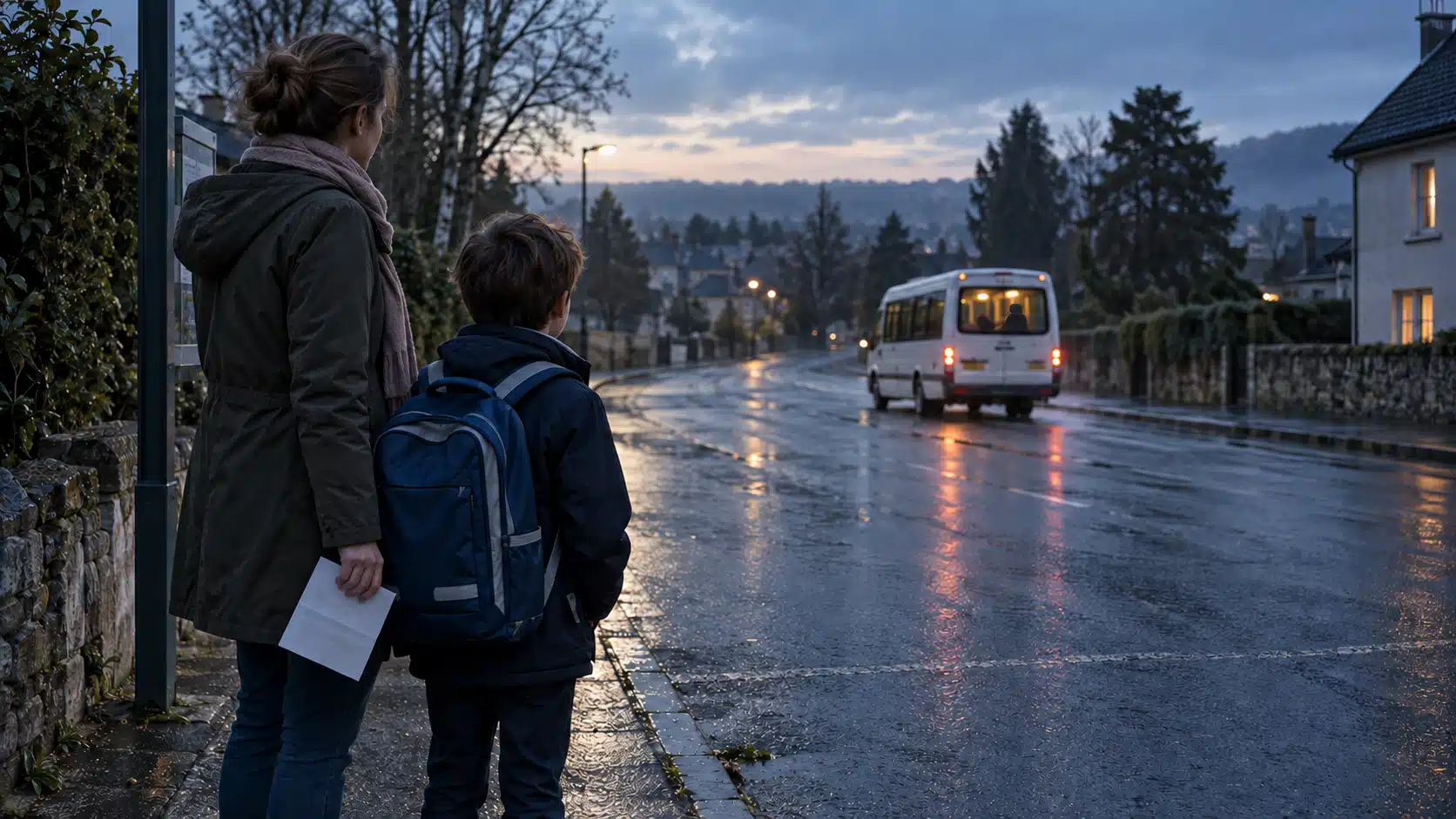
A child does not know that a threshold has been crossed. He knows only that the school bus used to stop on his street and, one morning, it does not. His mother will understand more when the letter arrives. She will read it twice, perhaps three times, looking for the error that would allow her to object.
There will be no error. Every figure in the letter will be correct.
She will never meet the person who decided how much difference could be rounded away.
•
None of this makes calculation the enemy. Institutions without measurement can become arbitrary, and rules exist partly to prevent access from depending on influence, proximity or power. Numbers can reveal injustice with an honesty that human judgment often avoids.
The danger begins when precision is mistaken for truth.
Precision can tell us that a line has been drawn accurately. It cannot tell us whether the line belongs there, or whether the reality on either side of it resembles the distinction the system claims to have found.
•
A humane institution does not need to abandon numbers. It needs to preserve a place where the result may still be questioned after the arithmetic has finished — a place where someone can say that the calculation is correct and that the institution remains responsible for what follows from it.
That sentence is uncomfortable because it removes the safest defence a system possesses. If correctness is not enough, then compliance cannot be the end of responsibility. If a rule operates exactly as intended and still causes harm, the problem cannot be assigned to a careless employee, an exceptional case or a technical failure.
It belongs to the design.
And design has authors, even when their names no longer appear on the documents.
•
The most sophisticated systems of power do not need to hide what they are doing. They can publish the formula, record every decision and pass every audit. Their protection comes from something simpler: our willingness to stop looking once the numbers agree.
Perhaps that is where scrutiny should begin.
Not when the calculation is wrong.
When it is correct.