The Essay
— The Country That Won a War Without a Single Communiqué —

April 9, 1781. George Washington writes a line his biographers like to quote solemnly, though it’s really a distress call: “We are at the end of our tether, and that now or never our deliverance must come.” This isn’t rhetoric. Months earlier he’d had mutiny ringleaders executed in his own army over unpaid wages, and while marching south to intercept Cornwallis, another mutiny broke out in Philadelphia. An army mutinying against its own general isn’t about to win a war. It’s about to fall apart.
This is where the official script cuts to a commercial for France and Lafayette. And this is exactly where the script lies by omission.
Because while Washington was writing that line, a Spanish official named Francisco de Saavedra was landing in Havana with empty coffers. On July 17, 1781, he’d signed an agreement with French admiral De Grasse committing Spain to fund the operation — the problem being that Spain, at that exact moment, didn’t have the money on hand. Saavedra went door to door in Havana and talked merchants and private citizens into emptying their jewelry boxes. Within hours, he had 500,000 silver pesos.
On August 17, the French frigate Aigrette sailed out of Cuba carrying that silver and met the rest of the fleet the next day, bound for the Chesapeake. On September 5, in Virginia, American financier Robert Morris got the French army’s treasurer to hand over 26,600 of those pesos — the exact sum needed to pay, for the first and only time in the entire war, the Continental soldiers’ wages. A month later, Cornwallis surrendered at Yorktown.
Walk through that sequence slowly, because it’s worth the walk: an army mutinying over unpaid wages. A Spaniard going house to house to raise a fortune in hours. That silver crossing the Caribbean in a French frigate’s hold. An American financier handing it out, coin by coin, as the only pay those soldiers would ever see. None of it needs dressing up. It happened.
Across the Atlantic, in Cádiz, the same unsigned manual was holding up the Gulf of Mexico front under Bernardo de Gálvez: no flag, no dispatch, no trail — execute, then erase it. The U.S. Navy named a new frigate after Gálvez in 2024. Spain hasn’t gotten around to naming him a decent street.
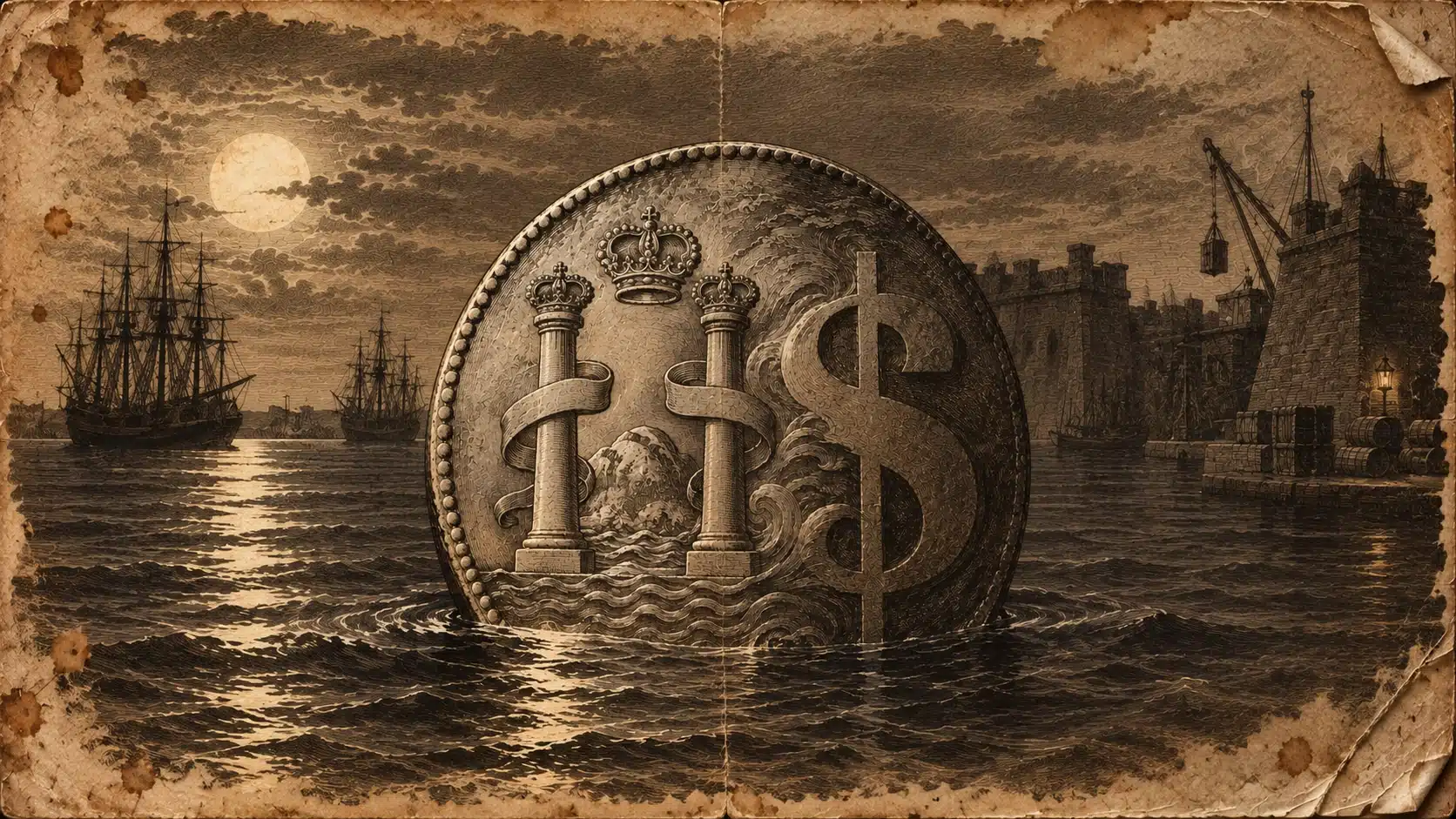
But the detail that should really unsettle a history textbook is smaller, and closer at hand: you’re carrying one in your wallet. According to a report from The Hispanic Council, backed by the U.S. Bureau of Engraving and Printing itself — the agency that literally designs the dollar — the “$” sign descends from the Spanish real de a ocho: the two Pillars of Hercules wrapped in the ribbon of the motto Plus Ultra, stylized down to the two bars crossing the S. Historian José María de Francisco Olmos, secretary of Spain’s Real Academia Matritense de Heráldica y Genealogía, describes it as a direct simplification of the Spanish royal coat of arms once its dynastic symbols were stripped away. It isn’t the only theory out there — a symbol this old never fully settles its own case — but it’s the one carried, on the record, by the agency that prints the bill.
Spain didn’t fire a single cannon at Yorktown. Emptying Havana’s jewelry boxes for one night was enough — and, in passing, handing the United States, unasked and unthanked, the symbol now stamped on every one of its bills.
—Copí
#HiddenHistory #AmericanRevolution #Spain1781