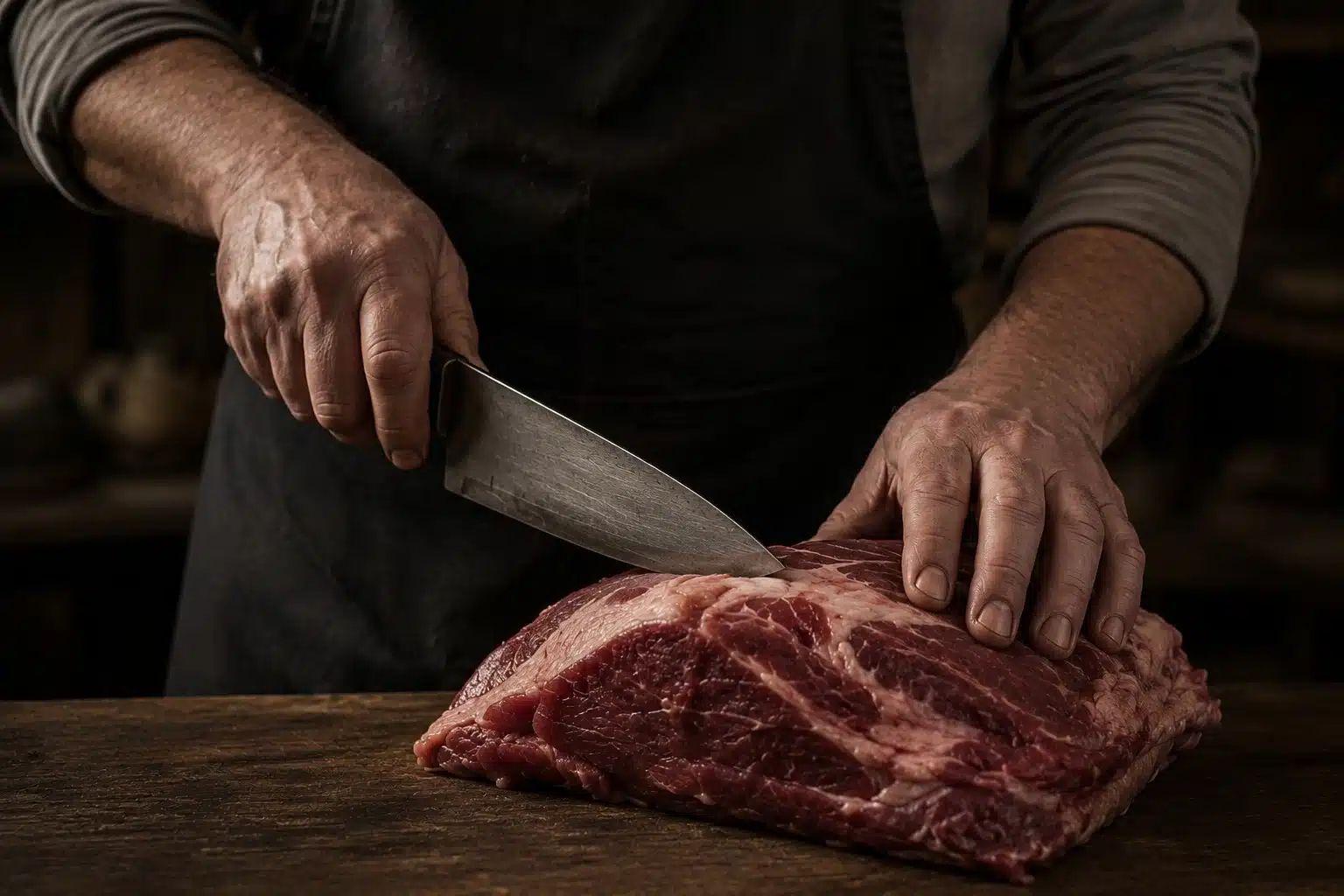

Trembling Flesh
For years I believed that mastering a craft meant mastering a tool.
I no longer believe that.
A tool can be learned.
A craft begins somewhere else.
It begins the moment another human being leaves something in your hands that you have no right to keep.
Not because it belongs to you.
Because, for a while, it will depend on you.
Looking back, I wonder whether every true vocation begins in exactly that way—not with skill, but with responsibility accepted before it is fully understood.
•
A young butcher thinks he has come to learn the knife.
He studies its weight.
Its edge.
Its certainty.
The old butcher studies something else.
Not the blade.
The place where the blade must stop.
Steel has only one instinct.
It moves forward.
Only the hand can decide where forward becomes too far.
Perhaps that is what every craft is really trying to teach.
Not precision.
Restraint.
•
We admire steady hands.
Clean movements.
Confidence earned through repetition.
Yet repetition carries a danger hidden from every apprentice.
One day the hand remembers what the heart no longer does.
The movement survives.
The reason quietly disappears.
Nothing looks different.
Everything is.
•
For a long time I thought experience protected us from failure.
Now I suspect it merely changes the kind of failure we are vulnerable to.
Inexperience wounds through ignorance.
Experience wounds through forgetting.
Not forgetting facts.
Forgetting purpose.
Forgetting what first justified learning the gesture.
•
I used to think corruption began with greed.
Or ambition.
Or cruelty.
I am no longer certain.
Now it seems to begin much earlier.
The day we stop remembering what was entrusted to us.
Everything that follows is only consequence.
The true collapse has already happened.
•
People speak easily about power.
I find myself thinking about trust instead.
Power can be seized.
Trust never can.
It is placed in another pair of hands with a question that rarely needs words.
Will this return still whole?
That question belongs equally to the surgeon, the judge, the teacher, the parent, the friend, the writer.
The names change.
The question does not.
•
There is a distinction our language rarely insists upon.
Managing is not the same as keeping.
Management asks how.
Custody asks for whom.
Management seeks efficiency.
Custody demands memory.
Perhaps what we call corruption is often nothing more dramatic than custody slowly giving way to management.
The technique remains.
Only the remembrance disappears.
•
Only recently did I understand why flesh trembles.
Not because knives exist.
Knives have always existed.
Flesh trembles because, sooner or later, every life must pass through someone else’s hands.
A child.
A promise.
A friendship.
A truth.
Hope itself.
For a brief moment, each depends upon another person’s memory of where the blade must stop.
Perhaps every civilization rests upon nothing stronger than that.
•
In the end, life will care very little about how skilful we became.
It will ask something quieter.
What returned to the world after passing through our hands?
Not what we achieved.
Not what we possessed.
Only whether what was entrusted to us left carrying less fear than when it first arrived.